


Global Mainstream Car Market | Germany - Basic National Conditions
2024-11-02 11:01:39
Click:
“
Global Mainstream Car Market | Germany - Basic National ConditionsSource:From Ga
”
Global Mainstream Car Market | Germany - Basic National Conditions
Source:From Gasgoo
The Chinese automotive industry is entering a new era of great navigation, and our overall vehicle product and supply chain capabilities have significantly improved, especially the development of intelligent electric vehicles, which is leading the world. And the external environment we are in is rapidly changing, with significant differences in political, economic, and social customs among countries in different regions. Access mechanisms, thresholds, market size, and competition also vary.
Based on global data from the Gaishi Automotive Research Institute, we have launched the "Global Mainstream Automotive Market" series. In this issue, we will mainly talk about the "cradle" of the global automotive industry and the largest automotive market in Europe - Germany.
Germany is the largest automobile producing and consuming country in Europe, with top global automobile manufacturers and suppliers. After entering the era of electrification, the German government has set ambitious climate protection goals, aiming to achieve 15 million electric vehicles on the road by 2030. However, in the first half of this year, the cumulative sales of electric vehicles in Germany decreased by 9% year-on-year to 273674 units, with a market share of 18.6% for new energy vehicles. Obviously, as a traditional automotive powerhouse, Germany has not been able to transform into a pioneer in the era of automotive electrification.
The Chinese automotive industry is entering a new era of great navigation, and our overall vehicle product and supply chain capabilities have significantly improved, especially the development of intelligent electric vehicles, which is leading the world. And the external environment we are in is rapidly changing, with huge differences in political and economic environments and social customs among countries in different regions.
Access mechanisms, thresholds, market sizes, and competition also vary. Combining with global data from the Gaishi Automotive Research Institute, we have launched the "Global Mainstream Automotive Market" series. In this issue, we will mainly talk about the "cradle" of the global automotive industry and the largest automotive market in Europe - Germany.
What kind of country is Germany? Let's provide a detailed presentation and analysis from the following aspects.
P1 Basic National Conditions 1. Germany's Basic National Conditions and Regional Advantages
- Geographical location
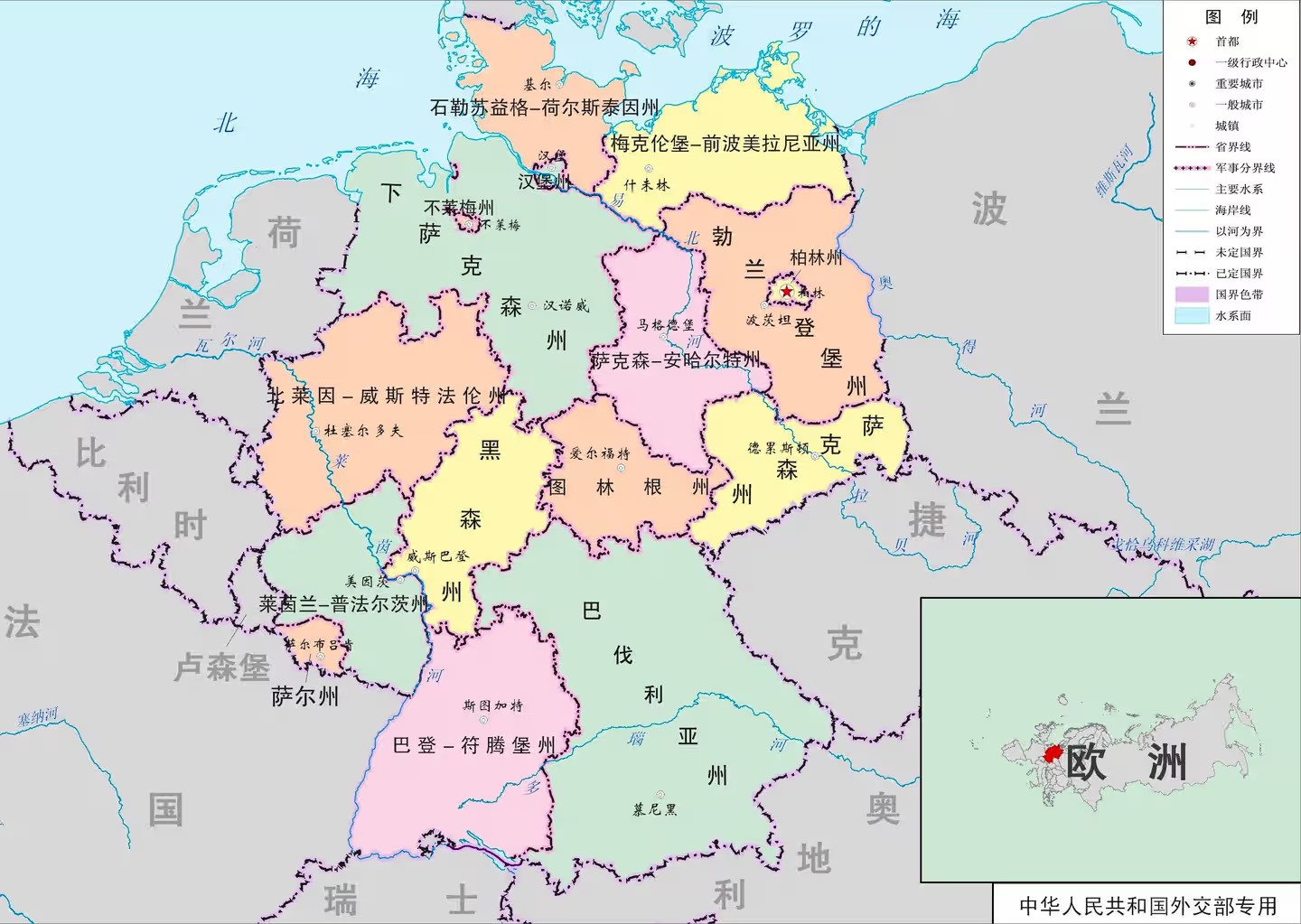
Germany is located at the center of the European continent and serves as a transportation hub connecting Western, Eastern, and Northern Europe. Germany borders Denmark to the north, Poland and the Czech Republic to the east, Austria and Switzerland to the south, France, Luxembourg, Belgium, and the Netherlands to the west, and is adjacent to the North Sea and the Baltic Sea. Its land border is 3876 kilometers long, and its coastline is 2389 kilometers long. This unique geographical location provides a natural advantage for the development of the German automotive industry, making it an ideal base for radiating the entire European market.
2. Land and Population
Germany has a land area of approximately 358000 square kilometers, making it the fourth largest country in the European Union by area. The terrain of Germany is diverse, with land levels rising in the south and falling in the north. It is divided into five regions, including the southern Bavarian Alps and the Alpine front, the southwestern Mid Range Trapezoids, Mid Range Uplifts, and the North German Lowlands. The Rhine, Danube, and Elbe rivers flow through Germany.
By 2024, Germany has a population of about 84.7 million, mainly Germans, and is the most populous country in the EU. Germany has a high population density, with the urbanization level reaching 77.5%. The urban population of Germany accounts for 88% of the total population, mainly distributed in Berlin, Hamburg, Munich, Bremen, Stuttgart, Cologne, Dusseldorf, Frankfurt and other cities. Germany's foreign personnel account for 12.8% of the total population, the largest number being Turks. Overseas Chinese living in Germany are mainly distributed in big cities such as Berlin, Frankfurt, and Hamburg.
It is worth noting that according to the June 2023 report by the German Federal Statistical Office, the proportion of the population aged 65 and above in the Federal Republic of Germany has reached 22%. At the same time, the proportion of people aged 15 and under has decreased from 23% to 14%. Worldwide, the median age of the German population is 44.8 years, second only to Japan's 48.7 years. The aging population issue will have a significant impact on Germany's future labor market and automobile consumption.
According to data released by the German Federal Statistical Office in January this year, despite the economic downturn, the number of employed people in Germany in 2023 is about 45.9 million, setting a record high since the reunification of Germany in 1990.
3. Transportation and Communications
Germany's transportation system is highly developed, including efficient highways, rail transit, water transportation, aviation, and the ongoing smart logistics system.
Among them, the Autobahn in Germany has a total length of over 13000 kilometers, making it one of the densest highway networks in Europe and the fourth longest highway network in the world after China, the United States, and Canada.
The railway system in Germany is also very developed, with a high-speed railway network covering major cities across the country, with a total operating mileage of 37900 kilometers, including railways for long-distance transportation and subways, urban railways, trams, etc. for short distance transportation. Deutsche Bahn DB is divided into intercity express trains (ICE), intercity trains (IC), intercity express trains (RE), and intercity trains (RB) based on operating speed. The fastest intercity express train (ICE) currently has 260 trains in operation, with a maximum speed of 200km/h to 300km/h.
Germany's inland waterway transportation is also very developed. Rivers such as the Rhine and Danube are important cross-border waterways that flow through Germany, with inland shipping accounting for 10% of the country's total freight volume annually. Germany heavily relies on inland waterway transportation for major commodities such as coal, steel, building materials, and chemical raw materials. Large enterprises such as BASF Chemicals and ThyssenKrupp Steel are built along rivers to facilitate waterway transportation.
But according to data from the Federal Statistical Office of Germany in March this year, the volume of inland waterway freight in Germany will drop to the lowest point since the reunification of the two Germanys in 2023. German industry insiders recently stated in an interview with CCTV News that this indicates that the current German economy is still in a downturn.
In addition, Germany currently has 106 international hub airports, including Frankfurt and Munich, providing convenient conditions for the import and export of automotive products. According to data, the total passenger volume of German air travel in 2023 is 186 million, an increase of 20.23% year-on-year. In terms of air cargo, according to data from the German Airports Association, the main contributor to the growth of air cargo volume in Germany in 2023 is Munich Airport, which is the only major aviation hub in Germany with an increase in cargo volume.
In 2023, the air cargo volume at Munich Airport increased by 6.6% year-on-year, with abdominal cargo accounting for a large share, growing by 11%. This growth is partly due to the resumption of direct flights to Chinese Mainland in the middle of last year, a new route to Bangalore in southern India, and four flights to Taipei every week. The popularity of these new routes is particularly popular among Bavarian exporters.
In terms of smart logistics systems, Germany has significantly improved logistics efficiency and significantly reduced logistics costs through technological innovation and improved management levels. For example, the input of raw materials and components, as well as the supply, warehousing, distribution, and transportation of finished products for large enterprises such as BMW and Mercedes Benz, are all completed through comprehensive logistics services provided by third-party logistics providers. Germany is actively promoting the informatization and standardization of logistics, vigorously developing artificial intelligence, attaching importance to the promotion of autonomous driving technology, and introducing relevant laws to ensure the development of smart logistics.
4. Natural resources
Germany's natural resources are relatively scarce, with approximately two-thirds of its primary energy requiring imports. The energy crisis caused by the Russia Ukraine war that began in 2022 has added insult to injury to Germany's gradually weakening economy. The director of the German Economic Research Institute, an authoritative German economic research institution, said that in 2022, Germany lost 100 billion euros (about 106.7 billion US dollars) in the Russia-Ukraine conflict and the soaring energy costs caused by it, which is almost 2.5% of its annual GDP.
This loss is mainly due to Germany's high dependence on Russian energy, especially the high proportion of energy intensive industries, which has greatly affected Germany's economy from the Ukrainian crisis. In addition, Russia's special military action against Ukraine has led to multiple rounds of sanctions imposed by European countries on Russia, involving Russian energy production, further exacerbating Germany's energy crisis and rising costs.
In response to this crisis, Germany has begun to take various measures to reduce its excessive dependence on energy sources such as Russian natural gas, strengthen economic cooperation with other countries through diversified energy supply chains, and seek alternative markets and investment areas in order to reduce the risks brought by energy supply instability.
The implementation and effectiveness of these measures will take time to evaluate, and in the short term, Germany still needs to face economic losses and cost pressures in industrial production caused by the energy crisis. But Germany has relatively abundant reserves of hard coal and lignite, with proven reserves of about 230 billion tons of hard coal and about 80 billion tons of lignite. In addition, Germany has abundant salt resources. The existence of these resources provides certain support for Germany's industrial and energy needs.
In recent years, Germany has vigorously developed renewable energy, with the proportion of wind and solar power generation continuously increasing. Although Germany lacks a large amount of raw materials needed for automobile manufacturing, its strong industrial foundation and technological innovation capabilities make up for this disadvantage.
5. Production factors
With an aging population and changes in the labor market, Germany is facing multiple challenges, including a shortage of skilled workers, a decrease in the number of active labor market participants, and changes in employment numbers.
According to data from the German Federal Labour Office, 183 occupational categories in Germany will face a shortage of skilled workers in 2023. Among 801 professions, nearly half of them lack employees, and the overall retirement age is between 63 and 67 years old. These data reflect the current situation of the German labor market, where the problem of continuous labor shortage is becoming increasingly severe as the "baby boomer generation" ages.
The education level of the German labor force is generally high, especially for technical talents. Its "dual system" vocational education system has trained a large number of high skilled talents for the automotive industry.
The "dual system" education model, which involves joint education between enterprises and vocational schools, allows students to learn theory in school while receiving practical skills training in enterprises. This model effectively combines educational resources with industry demand, and the works designed and manufactured by students are directly tested by the market, achieving tangible benefits. Thus, a large number of talents with practical experience and skills have been cultivated for the automotive industry.
In addition, Germany's education system is also strengthening close cooperation with the industry, such as conducting joint appraisal and training with the International Chamber of Commerce (IHK), introducing vocational qualification assessment standards and certificates, promoting Sino German vocational education cooperation, and other measures, further promoting the close integration of educational resources and the automotive industry.
It should be noted that labor costs in Germany are relatively high. Specifically, according to data from the German Federal Statistical Office, the labor cost in Germany in 2023 is 41.30 euros per hour, ranking sixth among the 27 member states of the European Union and about 30% higher than the EU average (31.80 euros). The labor cost in Germany's manufacturing industry is 46 euros per hour, which is about 44% higher than the EU average (32 euros) and ranks fourth; The labor cost in the service industry is 39.80 euros per hour, which is about 25% higher than the EU average (31.80 euros) and ranks seventh.
In addition, the welfare of German workers is good, with more holidays and shorter working hours in recent years, which has pushed up the manufacturing and research and development costs in Germany and accelerated the development of the automotive industry towards automation and intelligent manufacturing.
6. Macroeconomics
Germany is a typical developed country, the third largest exporter in the world, the third largest economic power in the world, and the largest economy in Europe.
In recent years, due to internal structural problems, rigid industrial structure, inflation, external energy crisis, multiple interest rate hikes by the European Central Bank, and weak global demand, the German economy has gradually experienced a recession.
In 2023, the total revenue of Germany's public finance will be 1.86 trillion euros, a year-on-year increase of 6%, and the total expenditure will be 1.95 trillion euros, a year-on-year increase of 4%. The total deficit of the national budget will be 91.873 billion euros. Germany's gross domestic product was 4.12 trillion euros, a year-on-year decrease of 0.3%, with a per capita gross domestic product of 48800 euros. According to the International Monetary Fund's (IMF) forecast, the German economy may perform the worst among the world's major economies in 2024. The institution also expects Germany's economic growth rate to reach 1.3% by 2025.
7. Foreign trade
Germany is a major trading nation in the world, maintaining trade relations with over 230 countries and regions. Nearly one-third of the country's workforce is engaged in jobs related to exports. It maintained its position as the world's largest exporter from 1986 to 1990 and from 2003 to 2008.
The total foreign trade volume of Germany in 2023 is 2.96 trillion euros, including exports of 1.59 trillion euros and imports of 1.37 trillion euros, with a surplus of 225 billion euros.
The main products exported by Germany include automobiles and parts, mechanical products, chemical products, communication technology, power supply and distribution equipment, and medical and chemical equipment. Taking automobiles as an example, in 2023, the export value of German automobiles and parts is about 240 billion euros, with China, the United States, and the United Kingdom being the main export markets for German automotive products. The main imported products include chemicals, automobiles, oil and gas, machinery, communication technology, and steel products.
The top five foreign trade partner countries of Germany in 2023 are China, the United States, the Netherlands, France, and Poland, with over half of imports and exports coming from or sold to EU countries.
In 2002, China surpassed Japan to become Germany's largest trading partner in Asia. In 2023, China will remain Germany's world's largest trading partner for the eighth year, with a bilateral trade volume of $206.78 billion, a year-on-year decrease of 8.7%. Among them, China's exports amounted to 100.57 billion US dollars, a year-on-year decrease of 13%; Imports amounted to 106.21 billion US dollars, a year-on-year decrease of 4.2%.
8. Diplomatic Politics
As a core member state of the European Union, Germany is a member of the EU, the Quad, G8, G20, OECD, and NATO, playing an important role in European and international affairs.
Germany also adheres to a multilateral foreign policy and actively participates in international cooperation. Germany has 229 diplomatic missions overseas and maintains diplomatic relations with over 190 countries.
Overall, the characteristics of Germany's foreign policy are mainly reflected in its pursuit of economic globalization and commercial interests, while maintaining EU unity and promoting European integration. On the one hand, German diplomacy aims to explore the maximum extent to which the framework of European integration can be "abandoned" from the perspective of pursuing commercial interests of economic globalization; On the other hand, Germany is exploring to what extent it sacrifices its economic interests in the global market in the name of maintaining EU unity and promoting European integration. This pursuit of balance reflects the underlying logic of German diplomacy, which is to find a suitable balance between economic globalization and European integration.
Author:
Tianjin Getes Testing Equipment Technology Develop
From:
https://auto.gasgoo.com/news/202410/31I70409184C1213.shtml#nav


Related Articles
-

top Global Mainstream Car Market | Spain: Automotive Market Landscape
GLOBAL MAINSTREAM CAR MARKET | SPAIN: AUTOMOTIVE MARKET LANDSCAPESource: Gasgoo(
View Details -
Debut at Moscow CTT EXPO | Getes Empowers Global Construction Machinery & New Energy with Advanced Testing Technology
Debut at Moscow CTT EXPO | Getes Empowers Global Construction Machinery & New En
View Details -
LiminDa Backed by USD 130 Million Performance Guarantee: Geters Supports Clients to Provide Testing Support for Global AI Liquid Cooling Supply Chains
LiminDa Backed by USD 130 Million Performance Guarantee: Geters Supports Clients
View Details -
May 26–29 | Join GTS at 2026 CTT EXPO in Moscow — A Grand Event for the Construction Machinery Industry
May 26–29 | Join GTS at 2026 CTT EXPO in Moscow — A Grand Event for the Construc
View Details -
New Energy Vehicle Thermal Management System Key Components Testing Solutions
New Energy Vehicle Thermal Management System Key Components Testing SolutionsIn
View Details -
Life Testing of Hydraulic Hose Assemblies: From Impulse to Burst—How to Verify a Hose’s Ultimate Limits
Life Testing of Hydraulic Hose Assemblies: From Impulse to Burst—How to Verify a
View Details -
The 6th Liquid Cooling Full-Chain Supply Chain Summit|Getes On-site Demonstration of Full-Link Liquid Cooling Testing Solutions
The 6th Liquid Cooling Full-Chain Supply Chain Summit|Getes On-site Demonstratio
View Details -
Getes to Attend Automotive Testing Expo Korea 2026
GETES TO ATTEND AUTOMOTIVE TESTING EXPO KOREA 2026Automotive Testing Expo Korea
View Details -
Witness the Hardcore Strength, Assist the Goal of Building a Powerful Military Country with Professionalism! Getes Organizes All Employees to Watch the Military Parade
Witness the Hardcore Strength, Assist the Goal of Building a Powerful Military C
View Details -
Getes' 2025 Inspirational Scholarship Award Ceremony for Employees' Children Successfully Held
'Aiding Education, Fulfilling Dreams, Setting Sail' | Getes' 2025 Inspirational
View Details -
Transnational Delivery! GETES Burst Test Bench and Flow Resistance & Pressure Difference Test Bench Shipped to Thailand
Transnational Delivery! GETES Burst Test Bench and Flow Resistance & Pressure Di
View Details -
Hose Assembly Pressure Test Bench
Information of Hose Assembly Pressure Test BenchHydraulic circuit test medium: e
View Details


CONTACT US
Tel:0086-22-87980566-615
0086-22-87980566-608
Fax:0086-22-87980568-612
Mob:+8618920080168
E-mail:zhixiong.cai@getes-china.com


Add WeChat

Scan the code to follow

点击右上角
分享给朋友吧
© Copyright - 2010-2023 : All Rights Reserved. 备案号:津ICP备19003794号-1  津公网安备12011102001143号 津公网安备12011102001686号
